
I consider anthropogenic global warming, AGW, a failed theory, but it still shuffles on like an animated corpse sustained by money, politics and the faithful. The faithful keep publishing junk science. I put a list together of the 10 worst climate science research papers in September 2008 [1]. I added to this list in April 2009 [2]. There was more by me published at Jo’s AGW ‘science’ has fallen over a cliff. Now I’m adding another ten papers to the worst list, so I guess it’s the ten recent worst.
Regards, Cohenite.
1. Distinctive climate signals in reanalysis of global ocean heat content. By Magdalena A. Balmaseda, Kevin E. Trenberth and Erland Kallen. Published in Geophysical Research Letters, 2013. http://onlinelibrary.wiley.com/doi/10.1002/grl.50382/abstract
Kevin Trenberth and his researchers have never been able to find the ‘missing heat’. Trenberth still insists it is at the bottom of the ocean. This is despite sea surface temperatures declining, demonstrable reasons why back radiation, the Deus ex machina of AGW, cannot heat the oceans and the top 700 meters of the ocean not warming, at least since the accurate measurement of Ocean Heat Content [OHC] began in 2003, as David Evans has shown.
Trenberth ignores all this and the basic point of how the bottom can heat while the middle and top don’t and explains why the deep ocean heat content is increasing: “Sensitivity experiments illustrate that surface wind variability is largely responsible for the changing ocean heat vertical distribution.”
So has there been increasing wind variability in the surface winds? Not according to the data!
2. Quantifying the consensus on anthropogenic global warming in the scientific literature. By John Cook et. al. Published in Environmental Research Letters, 2013 http://iopscience.iop.org/1748-9326/8/2/024024/article
The consensus is the mainstay of AGW ‘science’. According to Cook et. al. and many others it’s always the case that AGW is true because the majority of scientists say it is. But this is not science! It only takes one contradiction to disprove a scientific theory as Karl Popper’s swan analogy shows. John Cook’s latest paper promoting the ‘consensus’ has been critiqued by Jo, Watts, some German guys and by Lucia. Lucia and Brandon Schollenberger analyse Cook’s methodology and Guidelines for classifying climate papers into ‘support’ and ‘reject’ AGW categories and find that Cook’s paper disproves the consensus. That is, analysis of Cook et. al. suggests that more climate papers reject AGW. So has Cook disproved the consensus theory of AGW?
3. Influence of Urban Heating on the Global Temperature Land Average Using Rural Sites Identified from MODIS, Classifications. By Charlotte Wickham, Judith Curry, Don Groom, Robert Jacobsen, Richard Muller, Saul Perlmutter, Robert Rohde, Arthur Rosenfeld, Jonathan Wurtele.Unpublished. http://berkeleyearth.org/pdf/berkeley-earth-uhi.pdf
It has been claimed that Richard Muller was once a ‘sceptic’, before seeing the ‘truth’ about AGW. But Muller was never a sceptic. At Berkeley, Muller and his team have self-published a number of papers on temperature and other aspects of AGW. Peer review on these papers is incomplete, so in effect they are draft papers but they have had great influence even head-lighting the options at wood-for-trees. Major defects ranging from statistical methodology to ignoring or not allowing for UHIE have been levied against Muller. So what does his latest paper do? It purports to show there is NO UHIE. This is ridiculous. In a contemporaneous draft paper Watts employs the updated Leroy method to account for UHIE. Leroy 2010 used a new criteria for heat sinks based on their total surface area rather than distance from them. This gives a truer representation of UHIE since as urban centres grow the surface area of the heat islands increase. Muller however, simply attempts to distinguish between rural and urban areas. The problem is, as the incomparable Willis Eshenbach describes, Muller’s distinction between rural and urban is meaningless since his criteria classifies airports as rural; that is, some if not most of his rural sites are urban sites with UHIE.
4. Global Temperature Evolution 1979-2010. By Grant Foster and Stefan Rahmstorf. Published in Environmental Research Letters, 2011. http://iopscience.iop.org/1748-9326/6/4/044022
Continuing the theme of meaninglessness Foster and Ramstorf’s 2011 paper was meant to be the last word on climate sensitivity to CO2 increase. They removed all the natural factors that may have contributed to temperature increase and were left with a range of 0.014 to 0.018 K yr−1 as the ‘pure’ AGW forcing. This rate was constant from 1979. This should have set the alarm bells ringing for a start since CO2 was increasing exponentially during this period; if the dominant forcing factor was increasing the AGW temperature effect should also have been increasing. But it seems that their methodology was also flawed. By including a linear trend for warming in their analysis as an independent variable, Foster & Rahmstorf have demonstrated that global warming is well correlated with global warming. Futhermore Bob Tisdale shows Forster and Ramstorf were wrong to consider ENSO as an exogenous factor and to exclude it from their analysis.
5. A Reconstruction of Regional and Global Temperature for the Past 11,300 Years
By Shaun A. Marcott, Jeremy D. Shakun, Peter U. Clark, Alan C. Mix. Published in Science, March 2013. http://www.sciencemag.org/content/339/6124/1198.abstract?sid=a53ce5ae-7d84-4a54-bdf1-bdee207e8d7f
Climate scientists have attempted to establish that the current climate is exceptional by constructing hockeysticks. McShane and Wyner have demolished what was left of Mann’s hockeystick. But like a weed different forms keep regrowing. Two recent hockeysticks have emerged and they are true to type. The first was by Marcott and his team including Shakum, who we’ll get too soon. Marcott has it all: incorrect splicing, cherry-picking, inverted proxies, wrong signs, all the problems Mann had and then some including the fact that Marcott’s PhD thesis was almost identical except it did not have the modern day temperature ‘uptick’ or hockeystick blade. Still Marcott remains in print.
6. Evidence of unusual late 20th century warming from an Australasian temperature reconstruction spanning the last millennium. By Joëlle Gergis, Raphael Neukom, Steven J. Phipps, Ailie J.E. Gallant, David J. Karoly. Submitted to Journal of Climate http://climatehistory.com.au/wp-content/uploads/2009/12/Aus2K_JoC_Manuscript_and_Supplementary_April_2012_final.pdf
Another hockey stick was created by Gergis et. al. but quickly withdrawn because Gergis et. al. had only selected proxies which correlated with modern temperatures; however that selection process involved detrending both the modern temperature and the proxies. In other words they created proxies that confirmed the exceptional modern day temperature. As Nick Stokes showed when the detrending was removed there was no correlation and in fact significant difference between the proxies and modern temperature and therefore no way of knowing whether modern Australian temperature was exceptional. Gergis et. al. is the statistical equivalent of not being able to count to 10.
7. Global warming preceded by increasing carbon dioxide concentrations during the last deglaciation. By Jeremy D. Shakun, Peter U. Clark, Feng He, Shaun A. Marcott, Alan C.Mix, Zhengyu Liu, Bette Otto-Bliesner, Andreas Schmittner & Edouard Bard. Published in Nature, Volume 484, pages 49-54
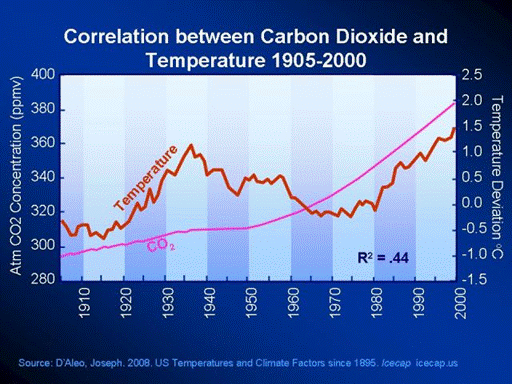
An insurmountable obstacle to AGW is that there is overwhelming evidence that CO2 does not move before temperature but at best as a response to it or arguably with no correlation at all; this is shown over all timespans: geological, 20thC and 21stC. So to argue as many do, that CO2 causes a temperature increase, is to argue against the data. That has never bothered AGW ‘science’ so we have two new papers saying either CO2 rises before temperature as Shakum does, or that there is synchronicity between CO2 and temperature as Parrenin et al argues. Shakum is easily dismissed because he bases his conclusion on a massive cherry pick of the only period in the last 20,000 years where CO2 appears to rise before temperature.
8. Synchronous Change of Atmospheric CO2 and Antarctic Temperature During the Last Deglacial Warming. By F. Parrenin, V. Masson-Delmotte, P. Köhler, D. Raynaud, D. Paillard, J. Schwander, C. Barbante, A. Landais, A. Wegner, J. Jouzel. Published in Science, Volume 339, pages 1060-1063
Parrenin et al. makes the same mistakes as Shakun but says carbon dioxide and temperature rise together. However, as Lansner’s brilliant [non-peer-reviewed] analysis of the ice-core data shows in Figure 5, over the 20,000 years since the last glacial equal levels of CO2 are at times correlated with both decreasing and increasing temperatures and high and low temperatures. The right cherry pick can disguise that complete lack of causal relationship which is what AGW ‘science’ in the Shakum and Parrenin papers has done.
9. Report of the Independent Inquiry into the Media and Media Regulation. By Ray Finkelstein QC. Published by the Australian government, March 2012. http://www.dbcde.gov.au/digital_economy/independent_media_inquiry
The Finkelstein’s enquiry was not primarily about climate science but its recommendations into press censorship comes down in favour of AGW on the basis of a gullible underclass being susceptible to a subversive media. The example used by Finkelstein is the press coverage of AGW and it’s associated issues like the carbon tax and in particular too much consideration being given to the sceptical position. What Finkelstein clearly indicates is that AGW is an elitist concept with our betters doing what is best for us even if that involves garden variety censorship.
10. Zero Carbon Australia Stationary Energy Plan. By Beyond Zero Emissions [BZE], 2010. http://media.bze.org.au/ZCA2020_Stationary_Energy_Synopsis_v1.pdf
This plan claims to present a mechanism for Australia to transition to 100 per cent renewable energy within ten years. This report, like the Finkelstein report, is also peripheral to the issue of climate science, but it plainly shows AGW is not scientific but a social and political ideology. BZE are an advocacy group for renewable energy. I used to think there may be something in renewable energy but then I grew up. The BZE plan was critiqued by Peter Lang and Martin Nicholson: 2 engineers, who agree. The main 2 provisos were that there should be at least a 60% drop in electricity demand at today’s usage that would mean an effective 70% plus drop on a per capita basis, and a cost up to over $4 billion. Both figures are highly conservative and I’m sure both Lang and Nicholson would agree that since 2010 the costs especially have sky rocketed. This is the heart of renewables; much less for much more. All justified by a science theory, AGW, which has no substance at all.
****
Links
1. Ten of the Worst Climate Research Papers: A Note from Cohenite, posted September 18, 2008 https://climatelab.com.au/2008/09/ten-of-the-worst-climate-research-papers-a-note-from-cohenite/
2. More worst AGW papers, by Cohenite posted on April 25, 2009 https://climatelab.com.au//2009/04/more-worst-agw-papers/


Hi CSR; you will be interested in this thread:
http://scienceofdoom.com/2010/06/22/venusian-mysteries-part-two/#comment-4403
And in particular this exchange between Mait and Dr Weinstein where Mait begins:
"I have a feeling that an equlibrium state of our model atmosphere is at neither thermal nor ‘convective’ equilibrium. Or to put it in another way, it is at dynamic equilibrium. The reason for this comes from the following assumptions (for an atmosphere with defined mass):
* In order to be convectively stable (no mass transfer), the pressure profile must be set by the gravity field. Or to put it in another way, if we look at a certain level in the atmosphere, the pressure under it has to equal the ‘weight’ of the gas above it. Otherwise pressure vs gravity is not equal and we would have movement of mass either up or down depending on which is higher – gas pressure below or weight above.
* If we consider that in an atmosphere, pressure is determined by large part by the mass of air above it (weight again), we will also have a certain density profile that would be needed to achieve this pressure profile (otherwise the change in mass above wouldn’t change the way we need it to in order to achieve the pressure gradient).
* As we have defined two of the three variables in the ideal gas law, pressure and density(density is considere to be n/V*R at the moment) the third one, temperature, ought to be a function of those two. While it is possible (I haven’t done any calculations) that it would give us a constant temperature, I believe it to be somewhat unlikely.
An important thing to note here is that if we remove all methods of heat transfer besides convection we can have an equlibrium state which is not isothermal. There is no violation with the zeroth law because top of the atmosphere and bottom of the atmosphere are thermally isolated. In order for the zeroth law to make any sense there has to be heat transfer and as we’ve shown that convection doesn’t happen any more, there is no heat transfer.
Now to more realistic situation where there is heat transfer.
If my guess is correct and the corresponding temperature profile is not constant we would get a situation where all static solutions would be unstable, as long as there is any amount of heat transfer. The reason for this lies in the ideal gas law and second law of thermodynamics. Ideal gas law says that we can’t change the temperature without messing up density and pressure, which means that any change in temperature will cause convection and the second law says that the temperature will change (Heat *will* move from hotter to colder areas). So we have the situation where neither is happy with any given solution and hence the stable one is determined by the balance between the speed of convection and the speed of thermal heat transfer.
So my understanding of the situation at the moment is that we have two extremum states between where the actual temperature profile lies. The first state is convectively stable state (no convection) which is achieved if thermal conductivity is zero, and the second state is isothermal, which requires thermal conductivity to be infinity (which is ofcourse impossible as well as things can’t really move faster than the light, at least in this context).
I must admit something seems terribly wrong with this line of logic at the moment, so I would very much appreciate where I’ve gotten lost."
Cheers
If you believe that planetary surface temperatures are all to do with radiative forcing rather than non-radiative heat transfers, then you are implicitly agreeing with IPCC authors (and Dr Roy Spencer) that a column of air in the troposphere would have been isothermal but for the assumed greenhouse effect. You are believing this because you are believing the 19th century simplification of the Second Law of Thermodynamics which said heat only transfers from hot to cold - a "law" which is indeed true for all radiation, but only strictly true in a horizontal plane for non-radiative heat transfer by conduction.
The Second Law of Thermodynamics in its modern form explains a process in which thermodynamic equilibrium "spontaneously evolves" and that thermodynamic equilibrium will be the state of greatest accessible entropy.
Now, thermodynamic equilibrium is not just about temperature, which is determined by the mean kinetic energy of molecules, and nothing else. Pressure, for example, does not control temperature. Thermodynamic equilibrium is a state in which total accessible energy (including potential energy) is homogeneous, because if it were not homogeneous, then work could be done and so entropy could still increase.
When such a state of thermodynamic equilibrium evolves in a vertical plane in any solid, liquid or gas, molecules at the top of a column will have more gravitational potential energy (PE), and so they must have less kinetic energy (KE), and so a lower temperature, than molecules at the bottom of the column. This state evolves spontaneously as molecules interchange PE and KE in free flight between collisions, and then share the adjusted KE during the next collision.
This postulate was put forward by the brilliant physicist Loschmidt in the 19th century, but has been swept under the carpet by those advocating that radiative forcing is necessary to explain the observed surface temperatures. Radiative forcing could never explain the mean temperature of the Venus surface, or that at the base of the troposphere of Uranus - or that at the surface of Earth.
The gravitationally induced temperature gradient in every planetary troposphere is fully sufficient to explain all planetary surface temperatures. All the weak attempts to disprove it, such as a thought experiment with a wire outside a cylinder of gas, are flawed, simply because they neglect the temperature gradient in the wire itself, or other similar oversights.
The gravity effect is a reality and the dispute is not an acceptable disagreement.
The issue is easy to resolve with a straight forward, correct understanding of the implications of the spontaneous process described in statements of the Second Law of Thermodynamics.
Hence radiative forcing is not what causes the warming, and so carbon dioxide has nothing to do with what is just natural climate change.